Jak těžké činky pro děti? Průvodce váhami, technikou a bezpečností
Kids ages 6 to 12 should start with their own body weight or light weights between 0.5 and 2 kg. Teens from 12 to 18 can gradually move up to 2 to 10 kg once they nail proper form. Never test how much weight a child can lift at max. Always begin with technique and movement quality, not numbers on the weight.
Strength training is safe for kids when you respect how their bodies work. The goal isn't to build muscle like adults do. It's to improve coordination, strength, and movement patterns. That foundation is what everything else builds on.
V kolika letech může dítě začít posilovat?
It depends what you mean by "strength training." Body-weight activities like squats, push-ups, and pull-ups work for kids of any age. Guided strength training with weights is fine around ages 6 to 7, as long as the child follows basic instructions and can focus during the session.
Health experts in America recommend 60 minutes of movement a day for kids, with strength work 3 times a week. That's not random. Physical activity in childhood directly shapes bone density, muscle coordination, and your ability to stay injury-free later.
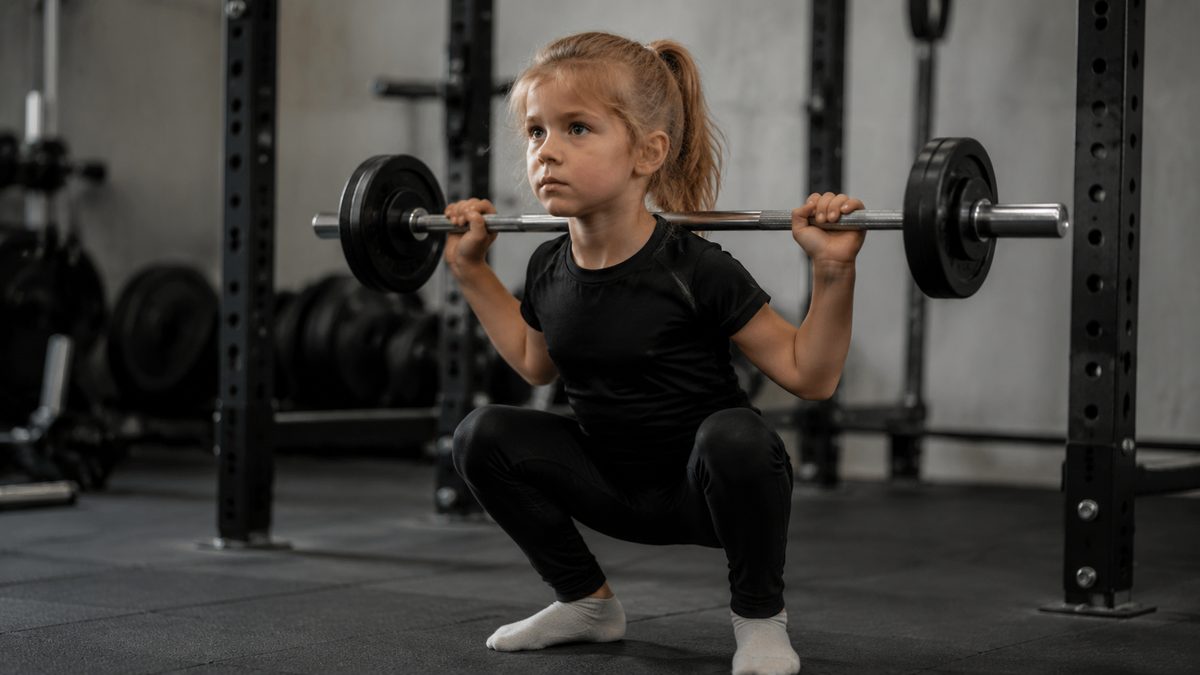
One thing most articles miss: being "ready" isn't just physical. Mental readiness matters too. Can the kid take feedback and focus on technique? That's just as important. I worked with an eight-year-old who did a perfect squat better than most adults, because she paid attention and wanted to learn.
Proč silový trénink dětem nebrání v růstu?
This myth won't die. But research is clear: proper strength training doesn't stop growth. The real problem is too much weight, bad form, or ignoring pain.
Fears about damaging growth plates came from 1980s data on high school athletes training without supervision. They had no coach, they lifted too heavy, and their technique was wrong. modern training fixes all that.
Studies show strength training builds muscle and endurance in kids without hurting growth. Kids' bones actually respond well to load. Training hardens them. That's a win, not a risk.
Jak těžké činky pro začátečníky bez ohledu na věk?
Simple rule: do 2 sets of 12 reps with perfect control before adding weight. This goes for any beginner.
Weight guides by age:
- Ages 6 to 9: Body weight or 0.5 to 1 kg
- Ages 9 to 12: 1 to 2 kg, up to 3 kg for some moves
- Ages 12 to 15: 2 to 5 kg, depends on the exercise and technique
- Ages 15 to 18: 5 to 10 kg, more for compound lifts with good form
Don't add weight because the kid wants it or a friend is using it. Go up 5 to 10% only when the child handles the current load smoothly, with no cheating and full range of motion.
I worked with a twelve-year-old girl who wanted 5 kg weights right away because she saw her older brother use them. We started at 1 kg and focused on overhead press form. Six weeks later, we moved to 2 kg. The result: a perfect movement pattern that keeps her safe when she plays sports. If we'd skipped that step, her shoulder would've been at risk.
Jak posilovat v 10 letech? Praktický rámec
A ten-year-old should follow this plan:
- 1 to 2 sets, 8 to 15 reps per exercise
- Weight is about 40 to 60% of their theoretical max (never actually test that max)
- Train 2 to 3 times a week, never two sessions back-to-back for the same muscles
- Rest 48 hours between sessions for the same muscle groups
Stick with compound moves: squats, light deadlifts, pull-ups, push-ups, and basic core work. Isolation moves like bicep curls don't make sense at this age. Movement patterns are the investment. Isolation isn't.
One study tracked teenage kayakers who did strength work twice a week for 24 weeks and found big gains in core and upper-body strength. That transfers to sports. And that's what matters for kids who already play.
Co dělat, když dítě nemá přístup k činkám?
Body weight is a full solution, not a backup plan. For kids up to 10 or 12, it's often the better choice. It trains coordination and awareness better than weights.
Real weight replacements:
- Resistance bands: variable resistance, low risk, works for any move
- Medicine balls: great for throws, rotations, and core work
- Squats, push-ups, pull-ups: all the strength a kid needs
Sources
- Falk B (2019) "The Safety of Resistance Training in Children—What Do We Really Know!" Pediatric Exercise Science. DOI: 10.1123/pes.2019-0143
- Barrett D (2006) "Effects of Neuromuscular Training and Resistance Training on Muscle Strength and Endurance Development in Children" Medicine & Science in Sports & Exercise. DOI: 10.1249/00005768-200605001-01819
- Spurrier D, Cook J, Bass S (2006) "Does weight training negatively effect longitudinal bone growth in children?" Journal of Science and Medicine in Sport. DOI: 10.1016/j.jsams.2006.12.096
- Nettle H, Sprogis E (2011) "Pediatric exercise: truth and/or consequences" Sports medicine and arthroscopy review. PMID: 21293241
- (1984) "Weight training-related injuries in the high school athlete" Journal of Safety Research. DOI: 10.1016/0022-4375(84)90018-5
- Lee T, Ko B, Chang C, Cheng I (2024) "Free-Weight Resistance Training Enhances Core Muscle Strength but Does Not Translate to Improved Athletic Performance in Adolescent Canoe/Kayak Athletes" Children. DOI: 10.3390/children11101177
- Sharvan Choudharya (2024) "Influence of Yoga and Physical Training on Adolescent’s Muscle Mass and Bone Weight" Anusandhanvallari. DOI: 10.52783/anuval.434
Kolik si vydělá Osobní trenér in Prague?
Read article →
Kolik stojí Osobní trenér in Prague?
Read article →
Jak dlouho denně cvičit, abych zhubla? Přesná odpověď podle vědy
Read article →
Kolik se dá zhubnout za 10 dní? Reálná čísla, ne sliby
Read article →
Jak často cvičit začátečník? Přesný plán pro první týdny
Read article →